 Call Us: 0800 999 0200

Electric motors play a crucial role in daily life, delivering power to a multitude of devices that keep our homes, offices and industries running smoothly. Although they power devices of many shapes and sizes, electrical motors are built on a simple yet rather astonishing idea: combining electrical and magnetic force to produce motion.
Many of us are unfamiliar with how motors work, with their process seeming somewhat mysterious, yet the motor’s ingenuity lies more in its capacity to harness the natural phenomena of magnetic fields to give life to daily appliances and machines.
Table of Contents
The Power Source
For all electrical motors, a power source is necessary to function. This energy may come from a power supply such as batteries, a generator or a mains power supply. The type of electricity has two varieties: direct current (DC), where the flow of electrons is steady and in one direction; and alternating current (AC), where the current rapidly changes in a back-and-forth motion.
Then comes the control of the electricity, typically governed by switches, controllers or inverters, ensuring the right amount of power reaches the motor in a steady manner. These controls also determine the speed of the motor’s spin and the strength of its turning force.
AC vs DC Motors
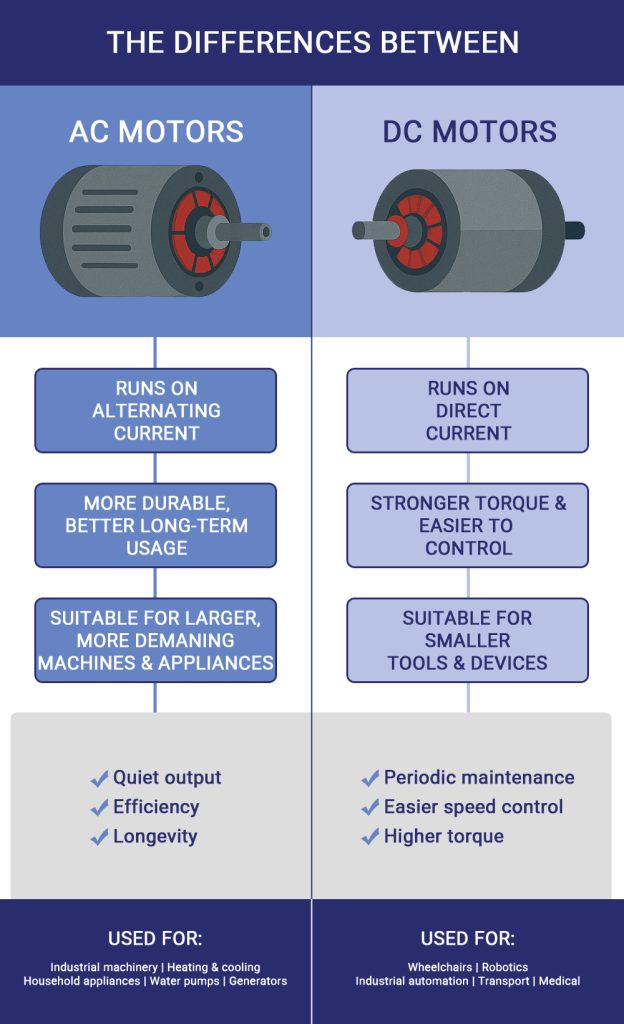
There are two primary types of electric motors: AC (alternating current) and DC (direct current). DC motors operate from a direct power source and use brushes and a commutator (a type of rotary electrical switch) to switch the current inside the spinning part of the motor. AC motors, however, use an alternating current to produce a rotating magnetic field that compels the rotor to spin.
In terms of their applicability, DC motors have an initially stronger torque and are generally easier to control, making them a more practical choice for smaller tools and devices. AC motors, however, show better long-term usage and durability, making them more suitable for larger, more demanding machines and appliances.
Inside an AC Motor
All AC motors use a rotating magnetic field that’s created by alternating current flowing through coils in the stator.
This happens when the magnet switches from a positive force to a negative force every half turn, creating magnetic resistance (as experienced when trying to push two positive sides of two magnets together) to naturally push the rotor away to the other side where it will meet the same opposing force – thus creating movement. This type of magnetic field also causes the inside of the motor to appear as if it’s moving around.
With this force in place, it naturally pushes the rotor around with minimal effort, with no need for additional features such as a commutator or brushes (like in a DC motor). AC motors are also known for their quiet output, efficiency, and longevity.
Inside a DC Motor
DC motors rely on internal switching systems to maintain their operation. The interior of the motor is composed of two parts that work in unison: the stator (which produces a steady magnetic field) and a rotor (a spinning coil inside the motor).
Electricity then flows into the two small carbon-made ‘brushes’ that are designed to be extremely lightweight yet durable and wear down slowly over time. These tiny brushes apply pressure to the rotating commutator, which is divided in small copper segments and which comes into contact with the brush fibres as it turns.
Once electricity reaches the motor coils, it creates an electromagnetic charge inside the rotor fed by the stator. Just like any regular magnet, the stator’s charge has a north and south pole, which is harnessed to rotate the rotor using a push-pull method, attracting the rotor to one side, then repelling it to the other and so on.
The Role of the Magnetic Fields
In order to fully understand how motors function, it’s important to take a deeper look into the role – and core – of every motor: magnets. This invisible force is initially generated by electricity, for example, when electricity passes down a wire, it naturally creates a magnetic field around that wire, and just like any magnet, it has both positive and negative charges.
This phenomenon is then used to build motors by arranging the wires and magnets in a specific way that directs the magnetic field. When electricity passes through the coil inside a motor, it becomes instantly electromagnetic. These coils then interact with an additional magnetic field created by the stator (by using its own electromagnets or permanent magnets) and a steady and rotating magnetic field is produced inside the motor.
The impressive part is when these two electromagnetic fields – one from the coil and one from the stator – meet to create a tug-of-war style push and pull relationship by constantly being repelled and attracted to their magnetic fields. The precision and timing of these reactions are so accurate that they create a smooth, spinning force with no wobble and contribute to the motor’s reputation of being silent and long-lasting.
Stator and Rotor
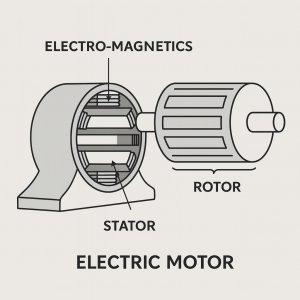
Inside every motor, two vital components can always be found: the stator and the rotor. These parts interact with each other through their respective magnetic fields, with the stator creating the magnetic field and the rotor responding to it.
The stator is the stationary, outer part of the motor that consists of a ring-shaped collection of metal plates and coils wrapped around specific sections. When electricity runs through these coils, two types of electromagnetic fields are generated, one being a steady magnetic field (as found in DC motors) or a rotating magnetic field (as found in AC motors).
The rotor is the spinning part fitted inside the stator and comes in two varieties: the first being a simple metal cylinder with small conductive bars (as found in induction motors) or a more complex build containing windings and a commutator (as found in DC motors). The rotor, which is also fixed to the shaft, begins to turn when it feels the magnetic force of the stator, delivering motion to the outside world.
In essence, these components represent the heart of the motor, as they transfer energy to each other through electromagnetic fields to create endless motion.
Delivering Power
Once power is delivered to the motor and the rotor is in motion, this energy is then transferred to the motor shaft. The motor shaft is a solid metal rod that’s directly attached to the rotor, which spins at the same speed and force as the rotor.
The shaft can be connected to a wide variety of mechanical systems, including gears, belts and chains, pumps and other tools such as drills and grinders. This happens through a simple process of one mechanism feeding the other: the motor creates rotation, the shaft then delivers the rotation, and the machine performs the rotation to fulfil a task.
On some occasions, additional mechanical components can be added to customise how the motor’s rotation behaves, but the basic principle always remains the same.
Conclusion
Understanding the simplicity yet intricacy of how electrical motors work gives us a far better idea of how even mundane objects contain a precise balance between natural phenomena and human engineering. By combining electricity and magnetism to create motion, our daily lives have been made exponentially easier at home, at the office and in the larger world around us.
For more information on electric motors, please get in touch today.


